


Compare Micro vs Macro vs Nano Influencers to find the best fit for your brand. Learn about engagement, ROI, audience reach, costs, and influencer marketing strategies in this complete 2026 guide.
Micro vs Macro vs Nano Influencers
The rise of social media has transformed the way brands connect with consumers. Traditional advertising is no longer the only way to build Brand Awareness or influence purchasing decisions. Today, businesses of all sizes—from startups to global enterprises—are investing in Influencer Marketing Strategy to reach highly engaged audiences through trusted Content Creators.
As the Creator Economy continues to grow, brands have more choices than ever when selecting influencers. But one of the most common questions marketers ask is: Should you work with Nano Influencers, Micro Influencers, Macro Influencers, or Mega Influencers?
The answer isn’t as simple as choosing the influencer with the highest Follower Count. While large influencers offer impressive Audience Reach, smaller creators often deliver stronger Engagement Rate, better Community Trust, and more Authentic Content. In many cases, the right Influencer Tier depends on your business goals, campaign budget, target market, and expected Return on Investment (ROI).
For example, a local skincare brand launching a new product may achieve better results by partnering with several Nano Influencers who have loyal local communities. On the other hand, an international fashion brand introducing a global collection may benefit from collaborating with Macro Influencers or even Mega Influencers to maximize visibility.
The challenge lies in making the right Influencer Selection based on measurable factors such as Audience Quality, Audience Demographics, campaign objectives, and Campaign Performance. It’s equally important to evaluate Audience Authenticity, identify Fake Followers through Influencer Fraud Detection tools, and monitor Influencer Analytics throughout the campaign.
This comprehensive guide will help you understand every influencer category, compare their strengths and weaknesses, and discover which influencer type aligns best with your marketing objectives. Whether your goal is increasing sales, improving Conversion Rate, generating User-Generated Content (UGC), or building long-term Brand Collaboration, you’ll gain practical insights to make smarter marketing decisions.
Understanding Influencer Tiers
Before comparing different influencer categories, it’s important to understand what an Influencer Tier actually means.
Influencers are generally classified based on their Follower Count, although modern influencer marketing also considers engagement, audience quality, content expertise, and niche authority.
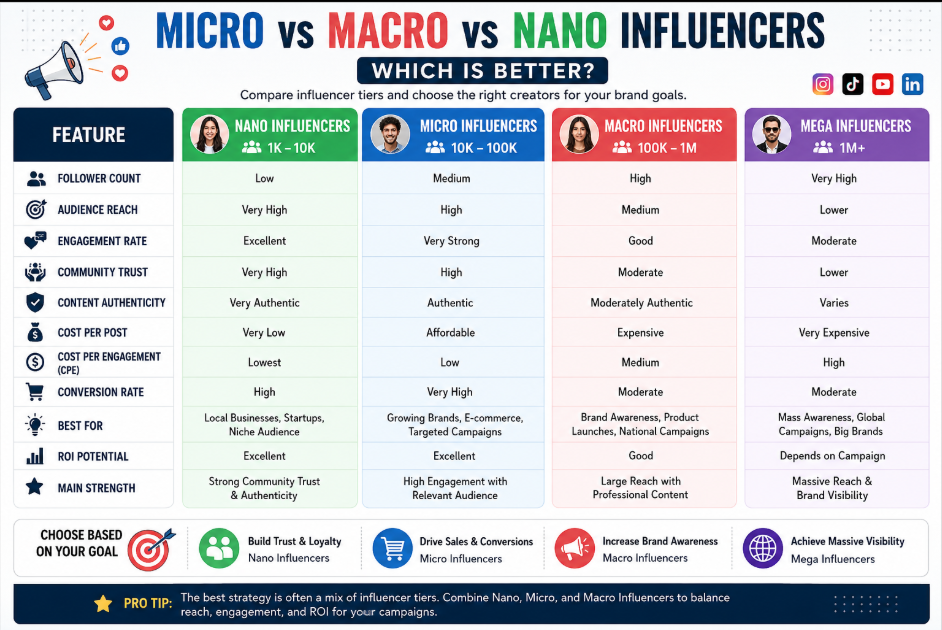
| Influencer Tier | Followers | Best For |
|---|---|---|
| Nano Influencers | 1K–10K | Local businesses, startups, niche communities |
| Micro Influencers | 10K–100K | Small and medium businesses, ecommerce brands |
| Macro Influencers | 100K–1M | National campaigns and established brands |
| Mega Influencers | 1M+ | Global campaigns and mass awareness |
While these ranges vary slightly across platforms, they provide a useful framework for choosing the right creator for your campaign.
However, choosing influencers solely by follower size is one of the biggest mistakes brands make.
Modern Influencer Marketing Strategy focuses on balancing several key factors, including:
- Audience Reach
- Engagement Rate
- Audience Quality
- Audience Authenticity
- Campaign Budget
- Cost per Post
- Cost per Engagement (CPE)
- Conversion Rate
- Purchase Intent
- Earned Media Value (EMV)
A creator with 8,000 highly engaged followers can sometimes outperform someone with 500,000 passive followers. That’s why brands increasingly prioritize meaningful engagement over vanity metrics.
Nano Influencers: Small Communities, Big Impact
Who Are Nano Influencers?
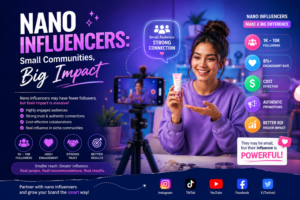
Nano Influencers are creators with approximately 1,000 to 10,000 followers. Although they have the smallest audience among influencer categories, they often maintain the closest relationships with their followers.
Their communities usually consist of friends, family members, local customers, and people who genuinely trust their recommendations. This close connection results in higher Community Trust and stronger purchasing influence.
Unlike celebrities, nano creators are perceived as everyday people sharing authentic experiences. Their recommendations often feel like advice from a friend rather than an advertisement.
Why Brands Love Nano Influencers
The biggest strength of nano creators is authenticity.
Consumers today are increasingly skeptical of polished advertisements and celebrity endorsements. Instead, they seek relatable people who share honest opinions.
Because of this, Nano Influencers frequently achieve:
- Higher Engagement Rate
- Better Audience Authenticity
- Stronger Brand Advocacy
- Improved Customer Trust
- More authentic conversations
Many nano creators specialize in specific niches such as:
- Fitness
- Parenting
- Technology
- Fashion
- Gaming
- Travel
- Finance
- Food
- Beauty
- Sustainable living
This allows brands to reach a highly focused Niche Audience that is genuinely interested in their products or services.
Example
Imagine a local coffee shop opening in Delhi.
Hiring a celebrity may generate attention, but collaborating with ten local Instagram Influencers who regularly review cafés could bring more customers through the door. Their followers already trust their recommendations, making them ideal partners for local campaigns.
Advantages of Nano Influencers
1. Exceptional Engagement
Nano creators typically maintain direct conversations with followers through comments, messages, and community discussions.
This often results in industry-leading Social Media Engagement.
Followers don’t simply “like” posts—they ask questions, seek recommendations, and share experiences.
2. High Audience Authenticity
Since most followers know the creator personally or discovered them through shared interests, Audience Authenticity tends to be much stronger.
Brands also encounter fewer issues with Fake Followers, making campaigns more reliable.
3. Affordable Campaigns
One of the biggest advantages is affordability.
Many nano creators collaborate through:
- Product exchanges
- Gifted products
- Small sponsorships
- Affiliate commissions
This significantly reduces Campaign Budget requirements.
Instead of spending thousands on one celebrity, businesses can partner with multiple nano creators simultaneously.
4. Better Cost per Engagement
Although their audience size is smaller, nano influencers often deliver an excellent Cost per Engagement (CPE).
Brands receive more comments, shares, and conversations for every dollar spent.
5. Strong User-Generated Content
Nano creators naturally produce relatable User-Generated Content (UGC).
Instead of looking like advertisements, their posts often resemble genuine customer experiences.
Brands can later reuse this authentic content across:
- Websites
- Product pages
- Social media
- Email campaigns
- Paid advertisements
Challenges of Nano Influencers
Despite their strengths, nano influencers aren’t perfect.
Limited Audience Reach
The most obvious limitation is Audience Reach.
A single nano creator cannot expose your brand to millions of people.
Large awareness campaigns usually require collaborations with dozens—or even hundreds—of nano creators.
Campaign Management
Working with multiple creators means coordinating:
- Contracts
- Deliverables
- Deadlines
- Content approvals
- Payments
Managing many small partnerships requires time and organization.
Limited Professional Experience
Some nano creators are new to influencer marketing.
They may require additional guidance regarding:
- Sponsored posts
- Content guidelines
- Brand messaging
- Campaign expectations
Brands should provide clear instructions to ensure successful Creator Partnerships.
Micro Influencers: The Perfect Balance
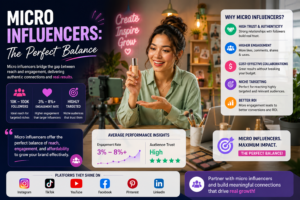
If nano influencers are known for authenticity, Micro Influencers are often considered the sweet spot of influencer marketing.
Typically having between 10,000 and 100,000 followers, they offer an ideal combination of reach, engagement, professionalism, and affordability. This balance makes them one of the most popular choices for brands across industries.
Why Micro Influencers Are So Effective
Unlike larger creators, Micro Influencers usually focus on a specific niche. Whether they specialize in fitness, personal finance, beauty, technology, travel, or home décor, they build loyal communities around shared interests rather than broad entertainment.
Because of this specialization, their followers often have stronger Purchase Intent. People follow them to discover products, learn from their expertise, and make informed buying decisions.
For brands, this means campaigns often generate not just visibility but meaningful actions—website visits, sign-ups, and purchases.
Strong Engagement with Growing Reach
Micro influencers maintain relatively high Engagement Rate while reaching a much larger audience than nano creators. They are often experienced in producing Sponsored Content that feels natural rather than overly promotional.
This combination of professionalism and authenticity helps brands achieve:
- Better Brand Awareness
- Higher Conversion Rate
- Increased Brand Affinity
- Improved Influencer ROI Measurement
They also tend to have access to platform insights and reporting tools, making Influencer Analytics easier to track and optimize.
Example
Imagine an online skincare brand launching a new serum. Instead of partnering with one celebrity, the brand collaborates with 20 beauty-focused TikTok Influencers and Instagram Influencers, each with around 30,000 followers.
These creators produce tutorials, honest reviews, and before-and-after videos. Their audiences actively engage with the content, ask product questions, and share their own experiences. As a result, the campaign generates high-quality User-Generated Content (UGC), strong engagement, and measurable sales—often delivering a higher Return on Investment (ROI) than a single high-profile endorsement.
Micro vs Macro vs Nano Influencers
Which Better?
Macro Influencers: Expanding Your Brand’s Reach
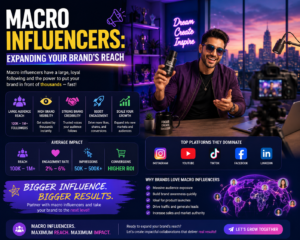
As brands grow, their marketing objectives often shift from targeting a small Niche Audience to reaching larger customer segments. This is where Macro Influencers become valuable.
Typically having between 100,000 and 1 million followers, Macro Influencers have built significant credibility and visibility within their industry. They are often recognized experts, professional creators, entrepreneurs, athletes, or public personalities who consistently produce high-quality content.
Unlike Nano Influencers and Micro Influencers, Macro Influencers focus on scaling their influence while maintaining a recognizable personal brand. They have professional content production teams, established media kits, and experience working with major companies.
For businesses looking to increase Brand Awareness across a wider audience, Macro Influencers can deliver exceptional results.
Why Brands Work with Macro Influencers
Macro creators offer the perfect middle ground between niche creators and celebrities.
They provide:
-
Large Audience Reach
-
Professional campaign execution
-
Strong content quality
-
Higher brand visibility
-
Multi-platform exposure
Many Macro Influencers are active across multiple channels, including:
-
Instagram Influencers
-
YouTube Influencers
-
TikTok Influencers
-
LinkedIn Influencers
This allows brands to launch integrated campaigns instead of relying on a single social platform.
Advantages of Macro Influencers
1. Massive Audience Reach
The biggest advantage is scale.
Instead of reaching thousands of people, Macro Influencers can expose your products to hundreds of thousands—or even millions—of potential customers.
For businesses launching new products nationally or internationally, this wider Audience Reach is invaluable.
2. Professional Content Creation
Most Macro Influencers have years of experience creating polished, engaging content.
Their videos, photography, storytelling, and editing are often comparable to professional advertising agencies.
This level of quality helps brands maintain a premium image while producing highly shareable Authentic Content.
3. Strong Campaign Performance
Because Macro Influencers understand marketing objectives, they are generally skilled at aligning content with campaign goals.
Brands can more easily measure:
-
Click-through rates
-
Website traffic
-
Sales
-
Leads
-
Customer engagement
This improves overall Campaign Performance and simplifies reporting through detailed Influencer Analytics.
4. Better Brand Recognition
Large creators help brands establish credibility.
Consumers often perceive brands working with respected influencers as more trustworthy, improving:
-
Brand Affinity
-
Customer Trust
-
Market positioning
Challenges of Macro Influencers
While Macro Influencers offer impressive visibility, they also come with certain limitations.
Higher Cost per Post
Professional creators typically charge premium rates.
The Cost per Post can range from several hundred dollars to tens of thousands depending on:
-
Platform
-
Industry
-
Location
-
Campaign duration
-
Content format
Brands need a well-planned Campaign Budget before working with Macro Influencers.
Lower Engagement Rate
As follower numbers increase, Engagement Rate often declines.
Although Macro Influencers have larger audiences, fewer followers may actively interact with every post compared to Nano or Micro creators.
This doesn’t necessarily reduce campaign effectiveness, but brands should compare engagement—not just follower numbers.
Broader Audience
Macro creators often attract followers with varied interests.
While this increases exposure, it may reduce targeting precision for highly specialized products.
Brands should evaluate Audience Demographics carefully before launching collaborations.
Mega Influencers: Maximum Visibility, Maximum Investment
At the top of the influencer hierarchy are Mega Influencers.
These creators usually have over 1 million followers and include:
-
Celebrities
-
Actors
-
Musicians
-
Sports personalities
-
Television hosts
-
Internet celebrities
Working with Mega Influencers is often comparable to running a national advertising campaign.
Their reach is unmatched, but so are their costs.
Benefits of Mega Influencers
1. Global Brand Awareness
If your objective is instant visibility, Mega Influencers are difficult to beat.
A single post can introduce your brand to millions of people within hours.
This is particularly useful for:
-
Global product launches
-
Fashion brands
-
Consumer electronics
-
Entertainment companies
-
Luxury products
2. High Media Exposure
Mega Influencers often generate:
-
Press coverage
-
Social sharing
-
News articles
-
Viral discussions
This increases Earned Media Value (EMV) beyond the sponsored campaign itself.
3. Strong Social Commerce Potential
Many celebrity creators successfully drive Social Commerce, especially during product launches or exclusive collaborations.
Platforms like Instagram Shop and TikTok Shop make it easier for consumers to purchase products directly after viewing influencer content.
Challenges of Mega Influencers
Despite their popularity, Mega Influencers aren’t the right choice for every business.
Extremely High Costs
Celebrity campaigns often require six- or seven-figure budgets.
For small businesses, the investment may outweigh the potential returns.
Lower Personal Connection
With millions of followers, direct interaction becomes difficult.
Compared to Nano or Micro creators, Mega Influencers generally have lower:
-
Community engagement
-
Personal conversations
-
Audience relationships
Less Niche Targeting
Mega Influencers appeal to broad audiences.
If your product serves a highly specialized market, working with smaller niche creators may produce better Conversion Rate and higher Return on Investment (ROI).
Comparison Table: Nano vs. Micro vs. Macro vs. Mega Influencers
| Factor | Nano | Micro | Macro | Mega |
|---|---|---|---|---|
| Followers | 1K–10K | 10K–100K | 100K–1M | 1M+ |
| Audience Reach | Low | Medium | High | Very High |
| Engagement Rate | Very High | High | Moderate | Lower |
| Community Trust | Excellent | Very Strong | Good | Moderate |
| Audience Authenticity | Excellent | High | Moderate | Varies |
| Cost per Post | Very Low | Affordable | Expensive | Very Expensive |
| Cost per Engagement (CPE) | Lowest | Low | Medium | High |
| Brand Awareness | Local | Regional | National | Global |
| Conversion Rate | High | Very High | Moderate | Moderate |
| ROI Potential | Excellent | Excellent | Good | Depends on campaign |
| Best For | Startups | Growing brands | Established businesses | Global enterprises |
Which Influencer Tier Is Best for Different Business Goals?
There is no single “best” influencer. The right choice depends entirely on your marketing objective.
Goal: Increase Brand Awareness
Choose:
-
Macro Influencers
-
Mega Influencers
These creators maximize visibility and introduce your brand to large audiences quickly.
Goal: Generate Sales
Choose:
-
Nano Influencers
-
Micro Influencers
Smaller creators typically influence stronger buying decisions because of their close relationship with followers.
Goal: Launch a New Product
An effective strategy combines multiple influencer tiers.
Example:
-
20 Nano Influencers for authentic reviews
-
10 Micro Influencers for tutorials
-
3 Macro Influencers for visibility
This balanced approach improves reach while maintaining authenticity.
Goal: Build Customer Trust
Smaller creators excel at building trust.
Their communities value honest recommendations and personal experiences more than celebrity endorsements.
This strengthens:
-
Customer Trust
-
Brand Advocacy
-
Long-term customer relationships
Goal: Create Authentic User-Generated Content
Brands looking to build content libraries should prioritize Nano and Micro Influencers.
Their natural product demonstrations often become valuable User-Generated Content (UGC) that can be reused across:
-
Websites
-
Product pages
-
Social ads
-
Email marketing
-
Landing pages
How to Choose the Right Influencer
Successful Influencer Discovery goes beyond follower numbers.
Before selecting a creator, evaluate these factors carefully.
1. Audience Quality
Ask:
-
Are followers genuine?
-
Do they interact regularly?
-
Does engagement appear natural?
A creator with fewer but real followers often delivers better results.
2. Audience Demographics
Review:
-
Age
-
Gender
-
Location
-
Interests
-
Purchasing behavior
The influencer’s audience should closely match your Target Audience.
3. Influencer Analytics
Request performance data such as:
-
Reach
-
Impressions
-
Engagement
-
Story views
-
Video completion rates
-
Website clicks
Reliable creators willingly share campaign metrics.
4. Influencer Fraud Detection
Unfortunately, some influencers purchase fake followers or engagement.
Always use fraud detection tools to evaluate:
-
Fake Followers
-
Suspicious engagement spikes
-
Bot activity
-
Audience authenticity
-
Engagement quality
Protecting your marketing investment starts with verifying creator credibility.
5. Brand Alignment
The influencer’s values should naturally align with your business.
Successful Brand Collaboration happens when the creator genuinely enjoys your products and communicates your message authentically.
Forced promotions rarely resonate with audiences.
Micro vs Macro vs Nano Influencers: which better?
Measuring Influencer Campaign Success: Beyond Likes and Followers
Launching an Influencer Campaign is only half the job. The real value comes from understanding whether your investment delivered meaningful business results. While likes and comments are visible metrics, successful brands measure deeper performance indicators that connect directly to business growth.
Every campaign should begin with clear objectives. Are you trying to increase Brand Awareness, generate leads, drive online sales, collect User-Generated Content (UGC), or strengthen Customer Trust? Once your goals are defined, you can choose the right metrics to evaluate success.
Key Metrics Every Brand Should Track
1. Engagement Rate
The Engagement Rate remains one of the most important indicators of audience interest. It measures how actively followers interact with content through likes, comments, shares, saves, and clicks.
A high engagement rate often indicates that an influencer has built genuine relationships with their audience rather than simply accumulating followers.
2. Conversion Rate
If your campaign’s objective is sales or lead generation, the Conversion Rate is one of the most valuable metrics.
Track how many users:
-
Purchase a product
-
Register for an event
-
Download an app
-
Subscribe to a newsletter
-
Request a consultation
A campaign with moderate reach but a high conversion rate often delivers better business value than one with millions of impressions.
3. Return on Investment (ROI)
Every marketing investment should generate measurable returns.
Return on Investment (ROI) compares the revenue generated against the total campaign cost.
For example:
-
Campaign Cost: $5,000
-
Revenue Generated: $20,000
This represents a strong positive ROI and demonstrates that the influencer partnership contributed directly to business growth.
4. Earned Media Value (EMV)
Earned Media Value (EMV) estimates the advertising value of organic exposure generated by influencer content.
It includes:
-
Social shares
-
Brand mentions
-
Media coverage
-
User conversations
-
Community discussions
A campaign with high EMV often continues delivering value long after the sponsored post has been published.
5. Influencer ROI Measurement
Modern brands rely on advanced Influencer ROI Measurement rather than vanity metrics.
This includes tracking:
-
Website traffic
-
Coupon code usage
-
Affiliate link sales
-
Customer acquisition cost
-
Repeat purchases
-
Lifetime customer value
By combining these insights with Influencer Analytics, businesses can continuously improve future campaigns.
Affiliate Marketing and Product Seeding: Increasing Campaign Effectiveness
Influencer collaborations don’t always need to involve large upfront payments.
Two strategies have become increasingly popular:
Affiliate Marketing
With Affiliate Marketing, creators receive a commission for every successful sale generated through their unique referral links or discount codes.
This approach benefits both parties:
Brands
-
Lower financial risk
-
Pay based on performance
-
Easier ROI tracking
-
Higher accountability
Influencers
-
Passive income opportunities
-
Incentive to create better content
-
Long-term earning potential
Affiliate marketing works especially well with Micro Influencers who have highly engaged communities.
Product Seeding
Product Seeding involves sending free products to carefully selected creators without requiring guaranteed promotion.
If influencers genuinely enjoy the product, they often create organic reviews, unboxing videos, or tutorials.
This strategy generates:
-
Authentic recommendations
-
High-quality User-Generated Content (UGC)
-
Stronger Community Trust
-
Increased Brand Advocacy
For startups with limited budgets, product seeding is an affordable way to build relationships with creators.
The Value of Long-Term Creator Partnerships
Many brands make the mistake of treating influencer collaborations as one-time campaigns.
In reality, Long-Term Partnerships often outperform short-term sponsorships.
When creators consistently use and recommend the same products, audiences begin to perceive the relationship as genuine rather than transactional.
Benefits include:
-
Stronger Brand Collaboration
-
Greater audience familiarity
-
Improved Customer Trust
-
Higher conversion rates
-
Consistent messaging
-
Better campaign optimization over time
Long-term Creator Partnerships also allow influencers to become true brand ambassadors who can tell deeper stories about your products and values.
Common Mistakes Brands Make
Even experienced marketers sometimes struggle with influencer campaigns. Avoiding these common mistakes can significantly improve results.
Choosing Influencers Based Only on Follower Count
A large Follower Count does not automatically translate into better performance.
Always evaluate:
-
Engagement
-
Audience relevance
-
Audience authenticity
-
Content quality
Ignoring Audience Quality
Not every follower is a potential customer.
Review Audience Quality carefully to ensure the influencer’s community aligns with your business objectives.
Failing to Check for Fake Followers
Unfortunately, influencer fraud still exists.
Use Influencer Fraud Detection tools to identify:
-
Purchased followers
-
Fake engagement
-
Bot activity
-
Suspicious growth patterns
Protecting your investment starts with choosing authentic creators.
Giving Too Many Creative Restrictions
Audiences follow influencers because of their unique voice and personality.
Allow creators enough creative freedom to produce Authentic Content that resonates naturally with their followers.
Measuring Only Likes
Likes are only one piece of the puzzle.
Track:
-
Clicks
-
Sales
-
Website visits
-
Conversions
-
Customer retention
-
Revenue
Business outcomes matter more than vanity metrics.
Influencer Marketing Trends Shaping the Future
The influencer landscape continues to evolve rapidly. Brands that stay ahead of these trends will have a competitive advantage.
Social Commerce Is Becoming Mainstream
Social Commerce allows users to discover, evaluate, and purchase products without leaving social media platforms.
Features like Instagram Shop, TikTok Shop, and YouTube Shopping are making influencer recommendations more actionable than ever.
Short-Form Video Continues to Dominate
Consumers increasingly prefer:
-
Instagram Reels
-
TikTok videos
-
YouTube Shorts
Brands should prioritize creators who excel at producing engaging short-form content.
Authenticity Over Perfection
Modern consumers appreciate honesty more than polished advertising.
Behind-the-scenes videos, product demonstrations, and real customer experiences consistently outperform overly scripted promotions.
Data-Driven Influencer Selection
Artificial intelligence and analytics platforms are making Influencer Discovery more sophisticated.
Brands now evaluate creators using:
-
Audience demographics
-
Engagement quality
-
Content relevance
-
Historical campaign performance
-
Purchase behavior
This data-driven approach reduces risk and improves campaign outcomes.
Frequently Asked Questions
Which influencer type offers the highest ROI?
For many businesses, Micro Influencers provide the best balance of affordability, engagement, and conversions. However, the ideal choice depends on your goals, audience, and budget.
Are Nano Influencers better than Macro Influencers?
Not necessarily. Nano Influencers excel at authenticity and trust, while Macro Influencers deliver larger reach. The better option depends on whether your priority is awareness, engagement, or sales.
How many influencers should a brand work with?
There is no fixed number. Small businesses may begin with 5–10 creators, while larger campaigns often involve dozens or even hundreds of influencers across different tiers.
Which social platform is best for influencer marketing?
The answer depends on your audience:
-
Instagram Influencers work well for lifestyle, fashion, beauty, and food brands.
-
TikTok Influencers excel at viral campaigns and younger audiences.
-
YouTube Influencers are ideal for detailed product reviews and educational content.
-
LinkedIn Influencers are highly effective for B2B marketing, professional services, and thought leadership.
Should brands work with multiple influencer tiers?
Yes. A combination of Nano Influencers, Micro Influencers, and Macro Influencers often creates a balanced campaign that delivers authenticity, engagement, and large-scale visibility.
Final Verdict: Which Influencer Is Better?
After comparing every influencer category, one thing becomes clear—there is no universal winner.
Each influencer tier serves a different purpose:
-
Nano Influencers are ideal for startups, local businesses, and brands seeking authentic community engagement.
-
Micro Influencers provide the best balance of trust, affordability, and measurable results, making them an excellent choice for most businesses.
-
Macro Influencers are perfect for established brands that want to expand nationally or internationally.
-
Mega Influencers are best suited for global campaigns where maximum visibility is the primary objective.
Instead of asking, “Which influencer is better?” ask, “Which influencer is better for my goals?”
The answer depends on your:
-
Marketing objectives
-
Campaign budget
-
Target audience
-
Industry
-
Timeline
-
Expected ROI
Brands that focus on audience relevance, authentic storytelling, and long-term relationships consistently outperform those chasing follower counts alone.
Conclusion
Influencer marketing has become one of the most powerful digital marketing strategies because it connects brands with people through trusted voices rather than traditional advertisements. Whether you choose Nano Influencers, Micro Influencers, Macro Influencers, or Mega Influencers, success comes from selecting creators whose audience genuinely aligns with your brand.
Take time to evaluate Audience Quality, analyze Influencer Analytics, verify authenticity, and set measurable goals before launching any campaign. Combine creative storytelling with data-driven decision-making, and you’ll be well-positioned to maximize Return on Investment (ROI), strengthen Brand Awareness, and build lasting customer relationships.
As the Creator Economy continues to evolve, brands that embrace authenticity, strategic partnerships, and continuous optimization will be the ones that stand out in an increasingly competitive digital landscape.
Ready to launch your next influencer campaign? Start by identifying the right creators, building meaningful relationships, and measuring every result. The most successful campaigns aren’t built on the biggest follower counts—they’re built on trust, relevance, and genuine connections that inspire audiences to take action.
FOLLOW US ON : INSTAGRAM , YOUTUBE ,WHATSAPP , DICICRACK